

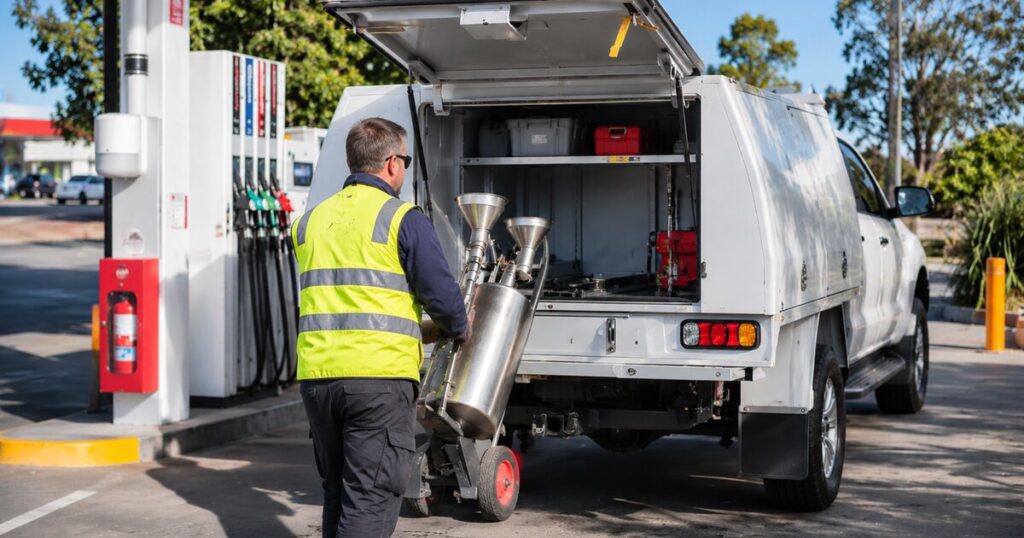
Nearly one in five retail fuel dispensers tested by the National Measurement Institute (NMI) in 2025–26 did not comply with trade measurement law. Almost as many of the faulty pumps were giving fuel away as were short-changing motorists, and that cost lands on the retailer’s margin, not the customer.
The national numbers
The NMI released its annual compliance results on 9 November 2026. Across the year, its inspectors tested 7,131 retail fuel dispensers, and 82 per cent complied. Four per cent were inaccurate to the consumer’s disadvantage. Five per cent were inaccurate to the consumer’s advantage, delivering more fuel than the customer paid for.
The figures sit in a familiar range. Over the past five years, the share of dispensers short-changing customers has run between 3 and 6 per cent each year. The last concentrated fuel audit, in 2019–20, found almost identical results.
The nine-week audit
Retail fuel was one of two concentrated programmes in 2025–26. It was planned as a four-week national audit starting in March 2026, then extended to nine weeks as the Middle East supply disruption pushed prices, and public scrutiny of pumps, higher. Inspectors audited 485 sites and tested around 3,200 dispensers, focusing on high-risk and new traders.
In that programme, 150 dispensers were inaccurate to the customer’s disadvantage, 142 were giving fuel away, and 148 were in use without being verified. Inspectors also collected fuel samples for the Fuel Quality Standard monitoring programme.
The complaints gap
Fuel dominates what the public reports. Of 646 complaints made to the NMI in 2025–26, 478 (74 per cent) were about fuel. After investigation, 26 of the fuel complaints were found to be justified.
Across all sectors, the NMI issued 1,940 non-compliance notices, 63 warning letters and 18 infringement notices totalling $90,665. Most traders fixed problems once inspectors explained their obligations, and 80 per cent of previously non-compliant traders were compliant when revisited.
What comes next
The NMI says dispenser accuracy remains a focus in 2026–27 under its measuring instruments programme. This year it also audited unmanned sites in regional and remote areas, including high-flow diesel and marina systems, so unattended formats are firmly in scope.
A note for independent operators
A dispenser giving away half a per cent on 100,000 litres a month hands over 500 litres, worth more than $1,000 at current prices. Short delivery carries the regulatory risk; over-delivery comes straight off your margin. Book regular calibration checks with your servicing technician, make sure any pump that has been installed or repaired is verified before it trades, and treat repeated customer complaints about one pump as a reason to test it.