

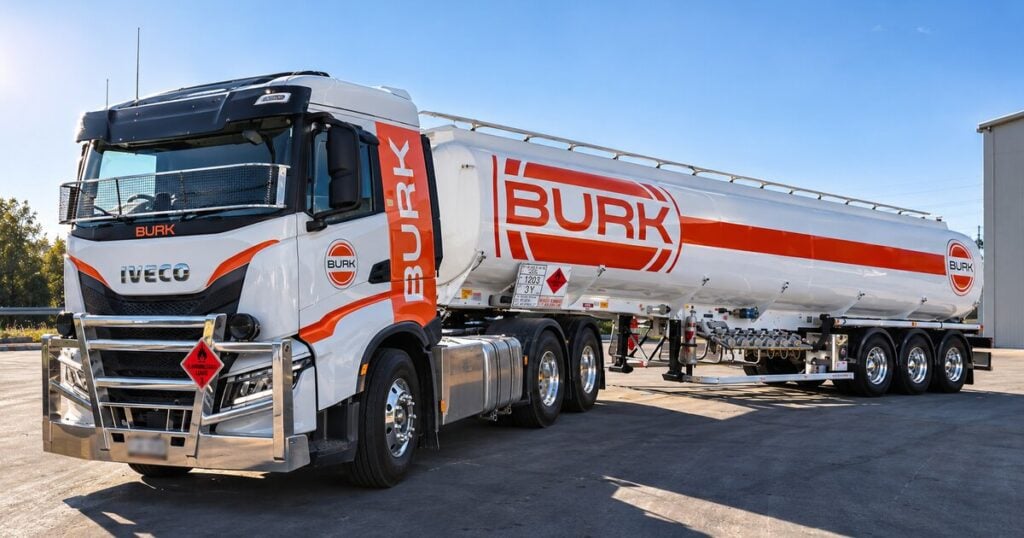
Court documents filed in the Supreme Court of Western Australia allege that Perth fuel chain Burk Fuel sold more than 7 million litres of Premium 98 between July 2025 and February 2026 while buying only 1.69 million litres of it. The strongest evidence in the claim is not a laboratory test. It is the gap between what went into the tanks and what came out of the bowsers, the same comparison every site’s own records already make possible.
The proceedings
On 9 November, WA’s Commissioner for Consumer Protection, Trish Blake, announced civil proceedings against Burk Fuel Pty Ltd, Burk Pty Ltd and their sole director, Umar Farooq. The case alleges false or misleading representations under the Australian Consumer Law. Independent testing in late 2025 and early 2026 found fuel sold as Premium 95 and Premium 98 was consistent with regular unleaded 91, according to the Commissioner. Consumer Protection ran the investigation with the federal Department of Climate Change, Energy, the Environment and Water, executing search warrants at metropolitan and regional sites. Burk operates 14 sites across Perth and regional WA, plus three in Victoria.
“When motorists choose to pay more for premium fuel, they should be able to rely on the information provided by the retailer,” Ms Blake said.
The volumes in the claim
The court documents, published on 12 November and reported by WAtoday, set out the purchase records. Customers paid for nearly 9 million litres of 95 over eight months, yet delivery logs over six months allegedly show no 95 delivered to Burk sites apart from one load of about 8,000 litres. For 98, sales of more than 7 million litres sit against 1.69 million litres purchased, with none bought at all in July 2025. Consumer Protection alleges Burk bought 14.7 million litres of 91 to make up the difference. Burk’s in-house trucking company, Burk Energy, is also named.
The Mount Lawley drop
That single 8,000-litre load of 95, delivered on 13 January, allegedly went into the 98 tank at Burk’s Mount Lawley site by mistake. Misdeliveries happen at well-run sites too. What separates an honest error from a pattern is whether the site recorded it, told the supplier and dealt with the product before selling it.
The WhatsApp group
According to the court documents, investigators found the discrepancies after discovering a WhatsApp group allegedly run by the company’s truck fleet manager, who is understood to have since left the country. Drivers were allegedly instructed to log every delivery on paper dockets. The claim alleges Mr Farooq took part in load planning discussions and lodged FuelWatch price notifications against the wrong products.
What the Commissioner is seeking
If the case is proven, Consumer Protection will ask the court for financial penalties, refunds to consumers, a five-year ban on Burk Fuel and Mr Farooq selling fuel in WA, and Mr Farooq’s disqualification from managing corporations. Ms Blake has advised motorists to keep their receipts in case a compensation scheme is ordered. She also told ABC Perth that samples taken from other traders came back exactly as advertised.
Burk’s position
Burk Fuel has disputed the allegations since the investigation became public in April. It says it sources fuel from a reputable supplier and runs regular quality checks, and it has said it will defend the proceedings. It is due to file a defence. None of the allegations has been tested in court.
For independent operators
The detail that matters for every other site is in Ms Blake’s own words to ABC Perth: the other samples were fine. Motorists will hear about Burk before they hear that, so expect questions at the console about premium fuel. Staff should have a simple answer ready.
The more useful lesson is how the case was built. The regulator didn’t need to catch the fuel in the act. It compared purchases against sales, grade by grade. Any site can run that check on itself:
- match every delivery docket to the tank it went into
- dip before and after each drop
- reconcile each grade on its own, not as a total
If a misdelivery happens, log it on the day, notify the supplier in writing and hold the affected grade until it’s sorted. Keep the supplier’s quality certificates on file. In WA, check that FuelWatch notifications sit against the right grade. A clean paper trail costs nothing until the day it’s the only thing standing between an honest mistake and an allegation.